Most beginner traders think small capital limits their success. In reality, small account trading psychology causes more damage than the account size itself.
A trader can have a profitable strategy and still lose money because fear, stress, and emotional decision making take control at the worst moments. Small accounts expose those weaknesses faster than large accounts.
That sounds painful, but it creates a massive advantage.
Trading with small capital gives you a low risk environment to build discipline, emotional control, and professional habits before serious money enters the picture.
The traders who survive long term usually master psychology before they scale account size.
The Paper Trading Paradox
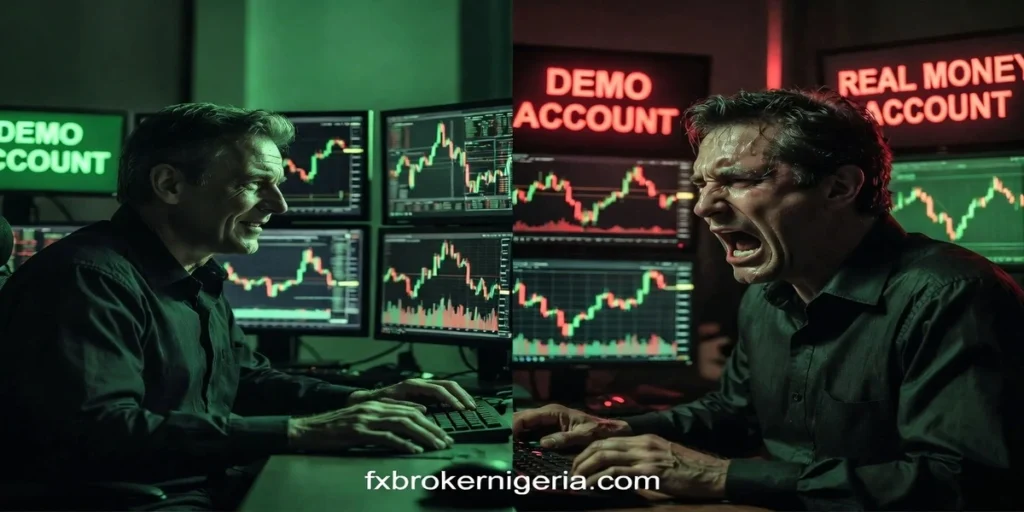
Many traders dominate in simulation accounts but collapse the moment real money enters the trade.
The strategy often stays the same. The chart stays the same. The setup stays the same.
The psychology changes completely.
The moment real money enters the market, your brain starts treating risk as a survival problem instead of a probability game. Even a tiny amount of money creates emotional pressure because you now have skin in the game.
Your primitive brain does not care that you only risked twenty dollars. It reacts to uncertainty and possible loss.
That reaction creates hesitation, overtrading, panic selling, revenge trading, and emotional exits.
This explains why paper trading vs real trading feels completely different. Simulation teaches mechanics. Real money exposes psychology.
Small capital helps close that gap safely.
Why Small Capital Feels More Emotional Than Large Capital
Most trading education focuses on percentages.
A mentor might say, “A two percent loss is the same on every account.”
Mathematically, that is true.
Psychologically, it is completely false.
Your brain does not process percentages emotionally. It processes real world meaning.
A fifty dollar loss may represent dinner, groceries, or a utility bill. A five hundred dollar loss may represent rent or a mortgage payment.
That emotional association changes how you execute trades.
This is why beginner traders often experience shaking hands, hesitation, or panic even with small positions. The brain attaches emotional value to the money instead of treating risk objectively.
Professional traders learn to separate money from emotional survival.
That separation takes training.
The Three Layers Of Trading Stress
Most emotional trading mistakes come from three psychological pressure points happening at the same time.
Absolute Money Stress
The first layer involves the actual dollar amount at risk.
If the loss feels meaningful to your daily life, emotional control becomes difficult.
A trader who risks grocery money will rarely follow a trading plan with consistency.
This is why many experienced traders recommend treating trading capital as tuition money.
Tuition creates a learning mindset instead of a survival mindset.
The goal shifts from “I must make money today” to “I am paying to develop skill.”
That psychological shift changes decision making dramatically.
Expectation Stress
Many beginner traders expect small accounts to produce unrealistic income quickly.
They try turning five hundred dollars into five thousand dollars within weeks. That pressure creates desperation.
Desperation destroys patience.
Patience creates edge in trading because good setups appear selectively. Impatient traders force trades because they feel pressure to produce results immediately.
Small account traders must remove unrealistic expectations early.
Professional growth happens slowly.
Identity Stress
The most dangerous layer involves identity.
Many traders unconsciously attach self worth to account performance.
A green day creates confidence and self respect. A red day creates shame, frustration, or self hatred.
That emotional attachment becomes toxic because trading outcomes contain randomness even when execution remains perfect.
Your P and L does not determine your value as a human being.
A losing trade means the trade lost money. It does not mean you are a failure.
The faster traders separate identity from results, the faster emotional stability improves.
Loss Aversion And The Fear Of Being Wrong
Behavioral psychology research consistently shows that people experience the pain of losses more intensely than the pleasure of gains.
In trading, this creates a destructive pattern.
Traders cut winners too early because they fear losing open profits. At the same time, they hold losing trades too long because they desperately want to break even.
The trade becomes emotional instead of logical.
Loss aversion also explains revenge trading.
After a painful loss, the brain seeks emotional recovery instead of objective execution. Traders suddenly increase size, abandon rules, or chase momentum impulsively.
They stop trying to trade well and start trying to erase emotional pain.
That mindset usually creates larger losses.
Professional traders accept losses quickly because they understand one important truth.
Losses are operating expenses in probabilistic systems.
No strategy wins every trade.
The Small Capital Advantage Most Traders Ignore
Small accounts create the safest possible environment to build trading psychology.
A beginner who trades massive size before building emotional control often develops destructive habits that become difficult to fix later.
Small capital reduces damage while exposing weaknesses clearly.
You learn:
- How fear affects execution
- How greed changes decision making
- How impatience creates bad entries
- How ego influences risk taking
- How stress affects discipline
Those lessons matter more than short term profits.
A trader who masters emotional control with small size can scale later with far more stability.
A trader who never builds emotional discipline usually loses larger amounts after scaling.
5 Psychological Rules For Small Account Traders
Treat Trading Losses As Tuition
Most traders view losses as personal failure.
That mindset creates emotional resistance and denial.
Instead, view early losses as education costs.
Every profession requires tuition in some form. Trading works the same way.
The key difference involves controlled tuition versus reckless destruction.
Small planned losses that teach discipline provide value. Emotional gambling does not.
Separate Self Worth From P And L
Your account balance measures trading performance, not human value.
A disciplined losing trade still counts as successful execution.
An impulsive winning trade still reinforces bad behavior.
Judge yourself based on process quality instead of short term outcomes.
That mindset reduces emotional volatility dramatically.
Use Minimally Viable Position Sizing
Most beginner traders trade too large because they chase excitement and fast profits.
That destroys emotional stability.
Instead, use minimally viable positions.
Trade one share if necessary.
The goal during early development involves building emotional intelligence and execution consistency without catastrophic losses.
Small positions create psychological repetition without overwhelming pressure.
Build Rules Before Emotions Appear
Emotions become dangerous during stress.
That means decision making must happen before entering trades.
Professional traders create hard coded safeguards such as:
- Daily loss limits
- Maximum position size rules
- Automatic liquidation levels
- Trading hour restrictions
- Maximum number of trades per day
These systems protect traders from psychological vulnerability during tilt and revenge trading episodes.
Rules reduce emotional improvisation.
Track Emotional Mistakes In A Journal
Most trading journals only track entries and exits.
That misses the most important information.
Track emotions at the moment of decision.
Write down:
- Fear level before entry
- Confidence level during execution
- Emotional state after losses
- Impulses to revenge trade
- Moments of hesitation
- Reasons for breaking rules
Patterns will appear quickly.
Many traders discover the same emotional mistakes repeat constantly under different market conditions.
Awareness creates improvement.
The Robotic Execution Plan
The best traders remove as much emotional guesswork as possible.
They operate like pilots following checklists.
A robotic execution plan should define:
- Entry criteria
- Risk per trade
- Stop placement
- Profit targets
- Exit rules
- Maximum daily loss
- Conditions for avoiding trades
The phrase “no exceptions” matters here.
Most psychological damage occurs when traders abandon systems emotionally.
Consistency creates stability.
Stability creates long term survival.
Ladder Scaling Instead Of Gambling
Many traders jump from tiny accounts to oversized positions too quickly.
That creates psychological shock.
A trader who performs well with one hundred dollar risk may collapse emotionally with one thousand dollar risk because emotional pressure increases faster than skill.
Professional scaling happens gradually.
Increase size step by step only after proving both performance and emotional consistency.
For example:
- Three months with no rule violations
- Consistent journal tracking
- Controlled emotional reactions after losses
- Stable execution during volatility
Scaling should reflect psychological readiness, not excitement.
Why Sleep Is A Trading Edge
Sleep directly affects emotional regulation, impulse control, discipline, and decision making.
Many traders obsess over indicators while ignoring biological performance.
Poor sleep increases:
- Emotional reactivity
- Impulsiveness
- Anxiety
- Stress sensitivity
- Decision fatigue
Strong sleep improves patience and emotional stability significantly.
For many traders, optimizing sleep provides higher return on investment than learning another strategy.
Psychology starts with biology.
Small Cap Trading Psychology
Small cap trading creates unique emotional challenges because volatility moves aggressively and quickly.
Why Volatility Is Normal
Many beginner traders interpret large price swings as danger signals.
In small cap trading, volatility often represents normal market behavior.
Ten percent to thirty percent daily moves can happen regularly.
Experienced traders stop treating volatility as emotional chaos and start treating it as structural reality.
That mental adjustment matters.
Volatility becomes easier to handle once traders expect it instead of fearing it.
The FOMO Trap
Thinly traded stocks often create emotional herd behavior.
Retail traders see rapid movement and feel urgency immediately.
Fear of missing out becomes overwhelming.
Unfortunately, intense FOMO usually signals late entry timing.
When emotions scream “buy now,” disciplined traders often step back and reassess objectively.
Patience protects capital.
Chasing excitement usually transfers money from emotional traders to disciplined traders.
Taking Profits Without Guilt
Many traders feel emotional pain after selling too early.
They watch prices continue higher and regret the decision immediately.
That mindset creates dangerous behavior because traders begin avoiding disciplined exits.
Selling into strength reflects discipline, not weakness.
No trader captures every percentage of a move consistently.
Professional traders focus on repeatable execution instead of fantasy exits.
The Shit List Exercise
One powerful exercise involves creating a brutally honest list of emotional mistakes.
Write down every destructive behavior you repeat.
Examples may include:
- Revenge trading
- Oversizing positions
- Moving stop losses
- Chasing breakouts emotionally
- Ignoring risk limits
- Holding losers too long
- Entering trades from boredom
This becomes your personal psychological weakness map.
Focus on reducing one mistake at a time.
Most traders try fixing everything simultaneously and change nothing.
Consistent improvement happens gradually.
Psychological Journaling For Traders
Technical analysis reveals market behavior.
Psychological journaling reveals your behavior.
That distinction matters.
Your emotional state often predicts performance quality better than strategy complexity.
Track emotional variables daily.
Notice what happens after poor sleep, stressful life events, winning streaks, or large losses.
Many traders discover they become reckless after success and fearful after failure.
That awareness helps create emotional consistency.
The goal involves understanding yourself as deeply as you understand charts.
Marriage To Risk
Many traders secretly hope uncertainty will disappear eventually.
It never does.
Risk remains permanent in trading.
Successful traders stop fighting uncertainty and learn to coexist with it calmly.
Think of risk as a long term partnership instead of a temporary obstacle.
That mindset changes everything.
You stop demanding certainty before execution.
You stop expecting perfect outcomes.
You stop reacting emotionally to normal losses.
Professional trading psychology begins when traders accept uncertainty emotionally instead of merely understanding it intellectually.
Emotional Trader vs Disciplined Trader
| Situation | Emotional Trader | Disciplined Trader |
|---|---|---|
| Losing trade | Holds and hopes | Exits at planned risk |
| Winning trade | Takes profit too early | Follows system |
| Volatility | Panics | Expects movement |
| FOMO | Chases entries | Waits patiently |
| Red day | Feels personal failure | Reviews execution |
| Small account | Tries to get rich fast | Treats it as training |
Conclusion
Small account trading psychology determines far more outcomes than strategy selection alone.
Most beginners focus entirely on indicators, setups, and market predictions while ignoring emotional execution.
That approach usually fails.
Small capital offers something more valuable than fast profits.
It offers a controlled environment for building discipline, emotional resilience, patience, and self awareness.
Those traits scale into larger accounts far more effectively than reckless aggression ever will.
In the end, successful trading is not only about building an account.
It is about building the person capable of managing one consistently.
don’t miss : best forex broker in nigeria
FAQ
Why do traders fail with small accounts?
Most traders fail because emotional pressure affects decision making. Fear, revenge trading, unrealistic expectations, and poor risk control damage performance more than account size itself.
Does paper trading help trading psychology?
Paper trading helps traders learn mechanics and strategy testing, but it cannot fully replicate the emotional pressure of real money trading.
What is the best position size for beginner traders?
Beginner traders should use minimally viable position sizing. Extremely small positions reduce emotional pressure and help build execution consistency safely.
Why do traders hold losing positions too long?
Loss aversion makes losses feel emotionally painful. Many traders hold losing trades because they want to avoid accepting the loss emotionally.
How can traders improve emotional discipline?
Traders improve discipline through structured rules, emotional journaling, proper sleep, consistent risk management, and gradual exposure to real market pressure.