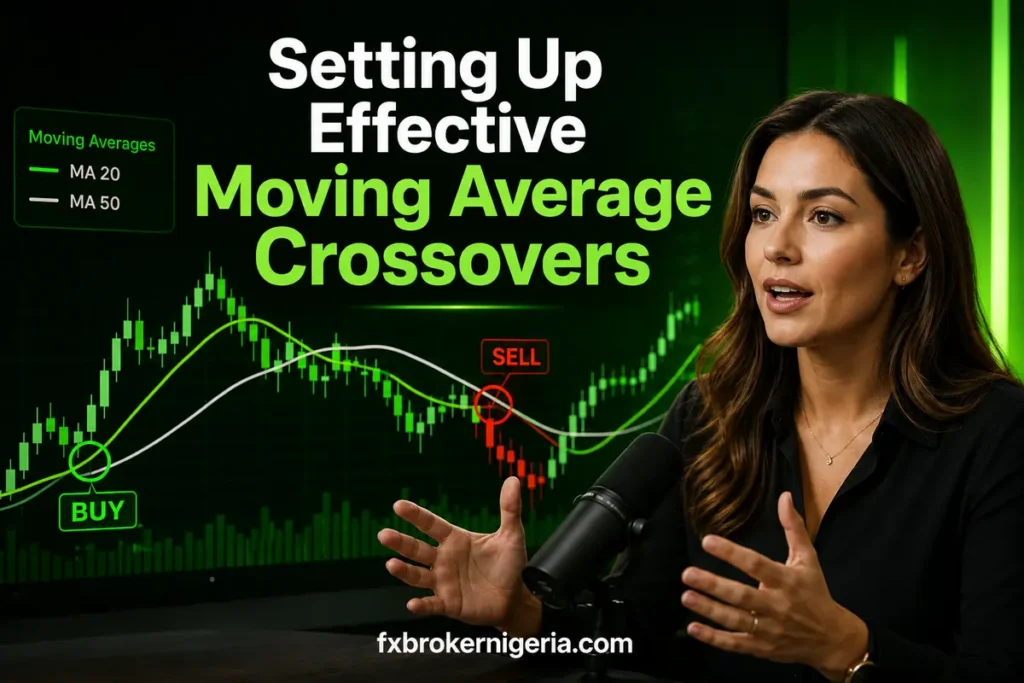
Moving average crossovers remain one of the most popular trading strategies in technical analysis.
The problem is not the indicator itself.
The problem is how most traders use it.
Many beginners treat every crossover as an automatic buy or sell signal. They jump into trades the moment two lines cross without considering market structure, volatility, trend strength, or psychological discipline.
That approach usually ends with frustration.
Effective moving average crossovers work best when traders stop treating them as magical signals and start using them as part of a broader decision making framework.
The goal is not to trade every crossover.
The goal is to identify meaningful momentum shifts that align with trend direction, price structure, and risk management.
Why Moving Average Crossovers Still Matter
Moving averages survive because they solve a real problem.
Markets create enormous amounts of noise. Price constantly fluctuates because of short term emotion, liquidity changes, and news reactions.
Moving averages smooth that noise.
They help traders see the underlying direction of market energy instead of reacting emotionally to every candle.
This matters because traders often confuse random movement with meaningful trend behavior.
A properly used moving average helps separate the two.
That said, moving averages are not predictive tools.
They are lagging indicators.
They react to price action after movement already begins. Traders who understand this limitation use crossovers more intelligently than traders searching for perfect entries.
What Moving Averages Actually Measure
Most traders memorize crossover patterns without understanding what the lines represent.
That creates shallow decision making.
Moving averages measure average price over time. They reveal where market participants collectively accepted value during a specific period.
In simple terms, they show the market’s center of gravity.
Why Traders Use Moving Averages
Moving averages help traders:
- Identify trend direction
- Filter market noise
- Spot momentum shifts
- Find dynamic support and resistance
- Measure mean reversion behavior
Institutions, swing traders, and algorithmic systems often monitor major moving averages closely. That attention creates self reinforcing reactions around important levels like the 50 SMA or 200 SMA.
Moving Averages As Market Energy Filters
Think of moving averages as energy filters instead of prediction tools.
When price trades above rising averages, bullish momentum usually dominates.
When price trades below falling averages, bearish pressure usually controls the market.
Crossovers matter because they signal a potential transfer of momentum between short term and long term participants.
SMA vs EMA: Which One Should You Use?
One of the biggest mistakes traders make involves using every moving average interchangeably.
Different moving averages serve different purposes.
When SMA Works Better
The Simple Moving Average gives equal weight to all candles within the calculation period.
That makes it slower and smoother.
Many professional traders prefer SMAs for higher timeframe analysis because institutions often respect them more consistently.
The 50 SMA and 200 SMA play major roles in long term trend analysis and mean reversion behavior.
SMA works best when:
- analyzing broader trends
- identifying institutional levels
- trading swing setups
- filtering market noise
When EMA Works Better
The Exponential Moving Average gives more weight to recent price action.
That makes it more responsive to momentum changes.
Short term traders often prefer EMAs because they adapt faster during trend acceleration.
EMA works best when:
- tracking short term momentum
- entering active trends
- trading breakout continuation
- reacting to volatility shifts
The key is understanding context instead of searching for a universally superior average.
Understanding Golden Cross And Death Cross
The Golden Cross and Death Cross remain essential concepts in moving average trading.
A Golden Cross happens when a shorter term moving average crosses above a longer term moving average, most commonly the 50 SMA crossing above the 200 SMA.
This suggests strengthening bullish momentum.
A Death Cross happens when the shorter moving average crosses below the longer moving average.
This suggests weakening market conditions.
These signals attract strong search interest because investors often use them for long term market analysis.
Still, traders should avoid treating them as automatic predictions.
Major crossovers can appear late after substantial movement already occurred.
That is the reality of lagging indicators.
Why Most Traders Fail With Moving Average Crossovers
Most crossover failures come from poor context rather than flawed indicators.
The Low Timeframe Trap
Backtesting repeatedly shows that crossover systems often struggle on lower timeframes like the 1 minute, 5 minute, and 15 minute charts.
Markets become noisy and directionless.
Price constantly shifts above and below moving averages without establishing meaningful trend continuation.
This creates whipsaws.
A whipsaw happens when a crossover triggers an entry, then quickly reverses and stops the trader out.
Lower timeframe traders experience this problem constantly because short term volatility creates false momentum signals.
Higher timeframes usually produce cleaner crossover behavior.
The 1 hour, 4 hour, and daily charts often provide more reliable trend structure.
False Signals And Whipsaws
Sideways markets destroy simplistic crossover systems.
When markets lack trend direction, moving averages constantly cross back and forth without generating sustained movement.
This creates emotional frustration because traders feel trapped in repeated small losses.
The important lesson is this:
A failed crossover does not always mean the trader made a mistake.
Sometimes the market simply lacks directional energy.
Professional traders treat whipsaws as information about market conditions instead of emotional failure.
Why Moving Averages Are Lagging Indicators
Moving averages follow price.
They do not predict price.
This distinction matters enormously.
Many beginners expect moving average crossovers to identify tops and bottoms precisely. That expectation creates disappointment because crossovers usually confirm trends after momentum already develops.
Smart traders accept the delay in exchange for stronger trend confirmation.
The History Check Most Traders Ignore
One of the most valuable crossover insights involves studying how an asset behaved historically around moving averages.
Before trading any crossover system, scroll backward on the chart.
Ask simple questions:
- Does this market respect moving averages consistently?
- Does price trend cleanly?
- Do crossovers produce continuation?
- Does the asset constantly chop sideways?
Some stocks, currency pairs, and crypto assets naturally respect moving averages better than others.
Others produce endless noise.
If historical crossover behavior looks chaotic, skip the market.
Not every asset fits every strategy.
This simple filter alone can dramatically improve trade selection quality.
The Smart Crossover Strategy (20 EMA / 50 SMA)
The 20 EMA and 50 SMA combination creates a balanced trend following system.
The 20 EMA tracks short term momentum while the 50 SMA represents broader market structure.
This setup works best on:
- 1 hour charts
- 4 hour charts
- daily charts
The crossover becomes stronger when:
- price breaks structure
- volume increases
- trend direction aligns
- support or resistance confirms the move
The goal is not speed.
The goal is cleaner momentum alignment.
The Trend Master Strategy (20 EMA / 200 SMA)
The 200 SMA acts like a market highway.
It reveals the dominant long term direction.
A simple but powerful rule improves crossover quality significantly:
Only take bullish 20 EMA crossovers when the 200 SMA slopes upward.
Only take bearish crossovers when the 200 SMA slopes downward.
This filter removes many low probability trades because it forces alignment with broader market direction.
Trend alignment matters more than crossover frequency.
The Clustering Concept: Why Multiple Moving Averages Matter
Most beginner traders only use two moving averages.
More advanced traders often monitor moving average clusters.
For example:
- 15 EMA
- 50 SMA
- 100 SMA
- 200 SMA
When several averages align closely together, they create statistical significance.
This clustering effect often signals compression before volatility expansion.
Think of it as market pressure building beneath the surface.
When price finally breaks away from clustered moving averages with momentum, stronger directional movement often follows.
The moving averages begin telling a broader story instead of generating isolated signals.
The Confluence System
Professional traders rarely trade moving averages in isolation.
They combine multiple forms of confirmation.
This process is called confluence.
Confluence increases probability because several independent factors support the same trade idea.
Support And Resistance
A bullish crossover directly above major support carries more weight than a crossover in empty space.
The same principle applies to resistance.
Horizontal levels matter because they represent areas where buyers and sellers previously reacted aggressively.
Combining structure with crossover signals improves context dramatically.
Trendlines
Trendlines add another layer of market logic.
For example:
- bullish crossover plus trendline breakout
- bearish crossover plus trendline rejection
This alignment helps confirm whether momentum genuinely shifts or simply fluctuates temporarily.
Volume And Momentum Confirmation
Volume helps validate crossover strength.
A crossover accompanied by strong participation carries more credibility than weak low volume movement.
Momentum indicators can also help traders avoid weak conditions during sideways markets.
The goal is stacking odds instead of relying on one signal alone.
Mean Reversion And Market Structure
Mean reversion explains why markets repeatedly return toward moving averages after extended movement.
Price rarely travels in straight lines forever.
Eventually markets become stretched emotionally and technically.
Moving averages help traders visualize this relationship.
Strong trends often pull back toward major moving averages before continuation.
Understanding mean reversion prevents emotional chasing because traders recognize that aggressive movement usually cools temporarily.
The Psychological Side Of Crossover Trading
Most crossover education ignores Psychology of Trading completely.
That is a major weakness.
Indicators do not execute trades.
Humans execute trades.
Discomfort As A Professional Signal
Professional trading often feels uncomfortable.
A trader may enter a valid crossover setup while emotions scream that the move already feels too extended.
Another trader may want to exit early because of temporary pullbacks.
Following the plan despite emotional discomfort separates disciplined traders from reactive traders.
Emotional comfort rarely produces trading edge.
Managing Overconfidence
Winning streaks create dangerous confidence spikes.
Many traders increase position size aggressively after several successful crossover trades.
That usually ends badly.
Market conditions constantly change.
Keep position sizing stable and systematic.
Confidence should come from process consistency, not recent profits.
Treating Losses As Market Feedback
A failed crossover provides information.
It may reveal:
- weak trend conditions
- low momentum
- range bound behavior
- emotional overtrading
Professional traders analyze failed trades objectively instead of reacting personally.
Losses become market feedback rather than emotional attacks.
Risk Management For Crossover Traders
Even strong crossover systems experience losing streaks.
Risk management protects survival.
Strong practices include:
- fixed percentage risk per trade
- predefined stop losses
- avoiding emotional averaging down
- limiting exposure during sideways markets
- reducing size after emotional instability
A strategy without risk management eventually collapses under volatility.
Common Mistakes Traders Make
The most common crossover mistakes include:
- Trading every crossover blindly
- Ignoring higher timeframe direction
- Using low timeframes excessively
- Chasing extended entries
- Ignoring support and resistance
- Oversizing after winning streaks
- Treating moving averages as predictive tools
- Refusing to accept whipsaws as normal
Most traders do not fail because the indicator fails.
They fail because execution lacks structure and discipline.
Good Crossover Setup vs Bad Crossover Setup
| Factor | Good Crossover Setup | Bad Crossover Setup |
|---|---|---|
| Timeframe | 1H, 4H, Daily | 1m to 15m charts |
| Market Condition | Clear trend | Sideways market |
| 200 SMA Direction | Strong slope | Flat direction |
| Volume | Increasing volume | Weak participation |
| Support And Resistance | Near key level | Random location |
| Historical Respect | Asset respects crossovers | Asset constantly whipsaws |
| Trade Confirmation | Multiple confluence signals | Only crossover alone |
| Trader Psychology | Patient and disciplined | Emotional and impulsive |
| Risk Management | Defined stop loss | No clear risk |
| Entry Timing | Planned setup | FOMO entry |
Conclusion
Moving average crossovers still work when traders stop using them mechanically.
The strongest crossover traders think in terms of probability, context, and confluence.
They understand that moving averages smooth market noise, reveal trend direction, and help visualize momentum shifts. At the same time, they respect the limitations of lagging indicators and avoid blind execution.
The difference between struggling traders and consistent traders rarely comes from the crossover itself.
It comes from:
- timeframe selection
- market structure awareness
- risk management
- emotional discipline
- patience during weak conditions
A crossover should not act as a command.
It should act as part of a broader market conversation.
Once traders understand that shift, moving averages become far more powerful.
FAQ
Are moving average crossovers profitable?
Moving average crossovers can work well during trending markets, especially on higher timeframes. They often struggle during sideways conditions with low momentum.
What is the best moving average crossover?
There is no universal best setup. Popular combinations include:
- 20 EMA and 50 SMA
- 50 SMA and 200 SMA
- 20 EMA and 200 SMA
The best choice depends on timeframe, market conditions, and strategy goals.
Why do moving average crossovers fail?
Most crossover failures happen during sideways markets where price constantly moves above and below moving averages without creating sustained trends.
Should traders use SMA or EMA?
SMA works better for long term structure and institutional levels. EMA works better for short term momentum and faster market reactions.
What timeframe works best for moving average crossovers?
Higher timeframes like the 1 hour, 4 hour, and daily charts usually produce cleaner crossover signals with fewer whipsaws.